


Description
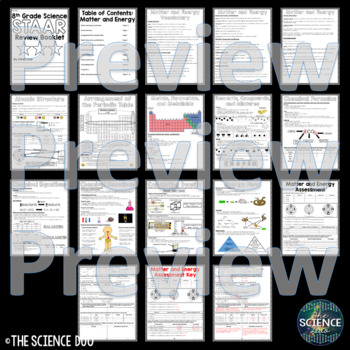
These 8th Grade Matter and Energy Exit Tickets (Exit Slips) are the perfect formative assessment activity for your students. They are quick, easy to use, and data driven. This resource contains 16 fully-editable exit ticket activities (4 per page) covering a large variety of matter and energy concepts (listed below). These slips are great to use at the beginning or end of a lesson, for concept reinforcement, stations, class reviews, or in small groups/tutorials. There are 2 versions included in this resource – Color and Black/White.
These exit tickets are aligned with TEKS 8.6A, 8.6B, 8.6C, 8.6D, and 8.6E.
Concepts covered in this product include the following:
- What are Elements, Compounds, and Mixtures? (8.6A)
- Homogeneous Mixtures vs. Heterogenous Mixtures (8.6A)
- Categorizing Elements, Compounds, and Mixtures (8.6A)
- Analyzing a Chemical Formula (8.6B)
- Molecules, Elements, and Atoms in Formulas (8.6B)
- Chemical Equation Basics (8.6B)
- Analyzing a Chemical Equation (8.6B)
- Cohesion, Adhesion, and Surface Tension (8.6C)
- Categorizing Cohesion, Adhesion, and Surface Tension (8.6C)
- pH Scale Basics (8.6D)
- How to Test for pH (8.6D)
- Identifying Acids and Bases (8.6D)
- Characteristics of Acids and Bases (8.6D)
- Law of Conservation of Mass Basics (8.6E)
- Law of Conservation of Mass – Atoms Practice (8.6E)
- Law of Conservation of Mass – Mass Practice (8.6E)
All answer keys and suggestions for use also included.
TEKS 8.6A – explain by modeling how matter is classified as elements, compounds, homogeneous mixtures, or heterogeneous mixtures
TEKS 8.6B – use the periodic table to identify the atoms involved in chemical reactions
TEKS 8.6C – describe the properties of cohesion, adhesion, and surface tension in water and relate to observable phenomena such as the formation of droplets, transport in plants, and insects walking on water
TEKS 8.6D – compare and contrast the properties of acids and bases, including pH relative to water
TEKS 8.6E – investigate how mass is conserved in chemical reactions and relate conservation of mass to the rearrangement of atoms using chemical equations, including photosynthesis
Terms of Use
© The Science Duo, LLC. All rights reserved.
License. Your purchase gives one teacher a license to use this resource with their own students. The license can’t be transferred. Each additional teacher, classroom, or school needs its own license. Please contact us about additional licenses.
Printing and copying. You may print and make copies for your own classroom instruction and for personal use.
Using it digitally with your students. You may share this resource digitally only in ways that limit access to your own students:
- through a learning management system that requires a student login (such as Google Classroom, Canvas, or Schoology)
- by email to your students or their parents/guardians
- through Google Drive or a similar service, shared with specific students only and never set to “anyone with the link”
- in recordings of your own teaching, shared privately with your students
Not permitted. You may not:
- post this resource on a public website, a shared or school-wide drive, or an open resource-sharing platform
- resell, redistribute, or claim the resource as your own
Clip art, fonts, and graphics belong to their creators and may not be extracted or reused outside this resource. Unauthorized sharing is copyright infringement under the Digital Millennium Copyright Act (DMCA).




Reviews
There are no reviews yet.