


Description
This Matter and Energy S.C.I.E.N.C.E. Station Bundle covers a variety of important 8th Grade Matter and Energy concepts such as elements, compounds, and mixtures, atoms in chemical reactions, cohesion, adhesion, and surface tension, acids and bases, and conservation of mass.
These station lab activities are designed to get your students engaged, collaborating, and moving in your daily lesson. Each station provides a different method for reinforcing important science content. All stations correlate to a task that is represented by a letter in the word SCIENCE. These stations will have students Summarize, Create, Interpret, Experiment, Navigate, Challenge, and Extend. You may choose to have your students work independently, with partners, or in small groups. All S.C.I.E.N.C.E. Stations are versatile and designed to be used in all of these scenarios. Upon completion of the stations, students will also reflect on the activity to communicate their level of understanding of matter and energy concepts.
This bundle covers TEKS 8.6A, 8.6B, 8.6C, 8.6D, and 8.6E.
The following 5 Matter and Energy S.C.I.E.N.C.E. Station Labs are included:
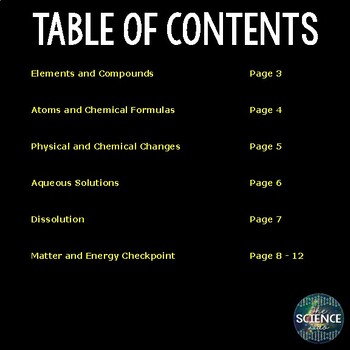
- Elements, Compounds, and Mixtures (8.6A)
- Atoms in Chemical Reactions (8.6B)
- Cohesion, Adhesion, and Surface Tension (8.6C)
- Acids and Bases (8.6D)
- Conservation of Mass (8.6E)
All resources in this download are fully-editable and include the following:
-Teacher Guide for implementing S.C.I.E.N.C.E. Stations (PRINT and READ FIRST)
-S.C.I.E.N.C.E. Station Signage
-General Directions for students
-Teacher Setup for specific stations
-7 station activities
-Student recording sheet and answer key
-Color and B&W options for all printable materials
-Tutorial for assigning “Challenge” cards and creating a PIN (video and written)
The Experiment Station for each station lab will require common materials from your science lab. Check out the preview of each station lab for more details.
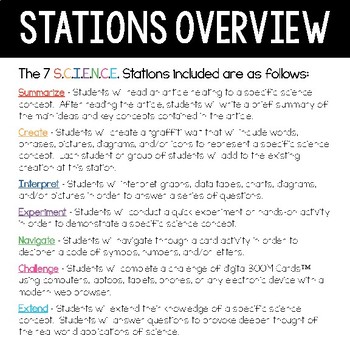
Descriptions of the 7 S.C.I.E.N.C.E. Stations included are as follows:
Summarize – Students will read an article relating to a specific science concept. After reading the article, students will write a brief summary of the main ideas and key concepts contained in the article.
Create – Students will create a “graffiti wall” that will include words, phrases, pictures, diagrams, and/or icons to represent a specific science concept. Each student or group of students will add to the existing creation at this station.
Interpret – Students will interpret graphs, data tables, charts, diagrams, and/or pictures in order to answer a series of questions.
Experiment – Students will conduct a quick experiment or hands-on activity in order to demonstrate a specific science concept.
Navigate – Students will navigate through a card activity in order to decipher a code of symbols, numbers, and/or letters.
Challenge – Students will complete a challenge of digital BOOM Cards™ using computers, laptops, tablets, phones, or any electronic device with a modern web browser.
Extend – Students will extend their knowledge of a specific science concept. Students will answer questions to provoke deeper thought of the real world applications of science.
S.C.I.E.N.C.E. Stations Suggestions for Use
• Use at the end of a unit of study to gauge student understanding
• Use as an assessment activity
• Use in tutorials or student pullouts for struggling learners
• Use as a review or reteach activity
• Use to increase overall student engagement
TEKS 8.6A – explain by modeling how matter is classified as elements, compounds, homogeneous mixtures, or heterogeneous mixtures
TEKS 8.6B – use the periodic table to identify the atoms involved in chemical reactions
TEKS 8.6C – describe the properties of cohesion, adhesion, and surface tension in water and relate to observable phenomena such as the formation of droplets, transport in plants, and insects walking on water
TEKS 8.6D – compare and contrast the properties of acids and bases, including pH relative to water
TEKS 8.6E – investigate how mass is conserved in chemical reactions and relate conservation of mass to the rearrangement of atoms using chemical equations, including photosynthesis
Terms of Use
© The Science Duo, LLC. All rights reserved.
License. Your purchase gives one teacher a license to use this resource with their own students. The license can’t be transferred. Each additional teacher, classroom, or school needs its own license. Please contact us about additional licenses.
Printing and copying. You may print and make copies for your own classroom instruction and for personal use.
Using it digitally with your students. You may share this resource digitally only in ways that limit access to your own students:
- through a learning management system that requires a student login (such as Google Classroom, Canvas, or Schoology)
- by email to your students or their parents/guardians
- through Google Drive or a similar service, shared with specific students only and never set to “anyone with the link”
- in recordings of your own teaching, shared privately with your students
Not permitted. You may not:
- post this resource on a public website, a shared or school-wide drive, or an open resource-sharing platform
- resell, redistribute, or claim the resource as your own
Clip art, fonts, and graphics belong to their creators and may not be extracted or reused outside this resource. Unauthorized sharing is copyright infringement under the Digital Millennium Copyright Act (DMCA).




Reviews
There are no reviews yet.